

Building resilient agriculture through legume value chains – the case of Good Nature Agro
Editor’s note: This article is an English translation of an article by Guillaume Simoes, AgriFI Senior Investment Officer in EDFI MC, originally published in French by Afrive. It has been republished here with attribution to the original author and publication.
Founded in 2016, EDFI Management Company is an investment platform that enables European development finance institutions and other partners to invest in high-impact projects in markets often considered too risky by conventional investors.
In this spirit, EDFI Management Company manages AgriFI, a €150 million impact investment fund financed by the European Union. AgriFI supports sustainable agricultural value chains, with a particular focus on the inclusion of smallholder farmers.
Global agriculture, and African agriculture in particular, faces a triple challenge: feeding a growing population, reducing its environmental footprint and adapting to climate change. According to the Food and Agriculture Organization of the United Nations (FAO), agrifood systems account for around one-third of global greenhouse-gas emissions. Key sources include agricultural production, land-use change and deforestation, livestock, and the manufacture and use of chemical fertilisers.
Synthetic fertilisers have played an important role in raising agricultural productivity and were central to the Green Revolution, particularly in Asia and Latin America. However, they carry significant economic and environmental costs.

Good Nature Agro, in Zambia, illustrates this ambition. More resilient production systems that are less dependent on synthetic nitrogen fertilizers are also being developed.
Their production is energy-intensive and remains heavily dependent on fossil fuels. Synthetic nitrogen fertilisers, nitrogen being a key nutrient for plant growth, are typically produced through the Haber-Bosch process, which combines nitrogen from the air with hydrogen under high pressure. As long as that hydrogen is produced from natural gas or other hydrocarbons, the process remains highly emissions-intensive.
It is estimated that producing one tonne of synthetic fertiliser can generate the equivalent of two tonnes of CO₂ emissions. Some projects are now exploring the production of nitrogen inputs using green hydrogen derived from renewable energy. However, the scalability and commercial viability of these technologies across different geographical contexts have yet to be demonstrated.
The environmental impact does not end with production. When applied in the field, synthetic fertilisers can also generate nitrous oxide, a greenhouse gas around 300 times more potent than CO₂. A study published in Scientific Reports estimates that the synthetic nitrogen fertiliser value chain accounts for 10.6% of global agricultural emissions.
In many African countries, reliance on imported inputs also exposes farmers to substantial price volatility. In this context, diversifying cropping systems and developing legume value chains offer a promising alternative.
Legumes play an important role in crop rotations. They can fix atmospheric nitrogen, helping to improve soil fertility and reduce fertiliser needs for subsequent crops. They also offer commercial opportunities and important nutritional benefits.
Good Nature Agro: a smallholder-focused model
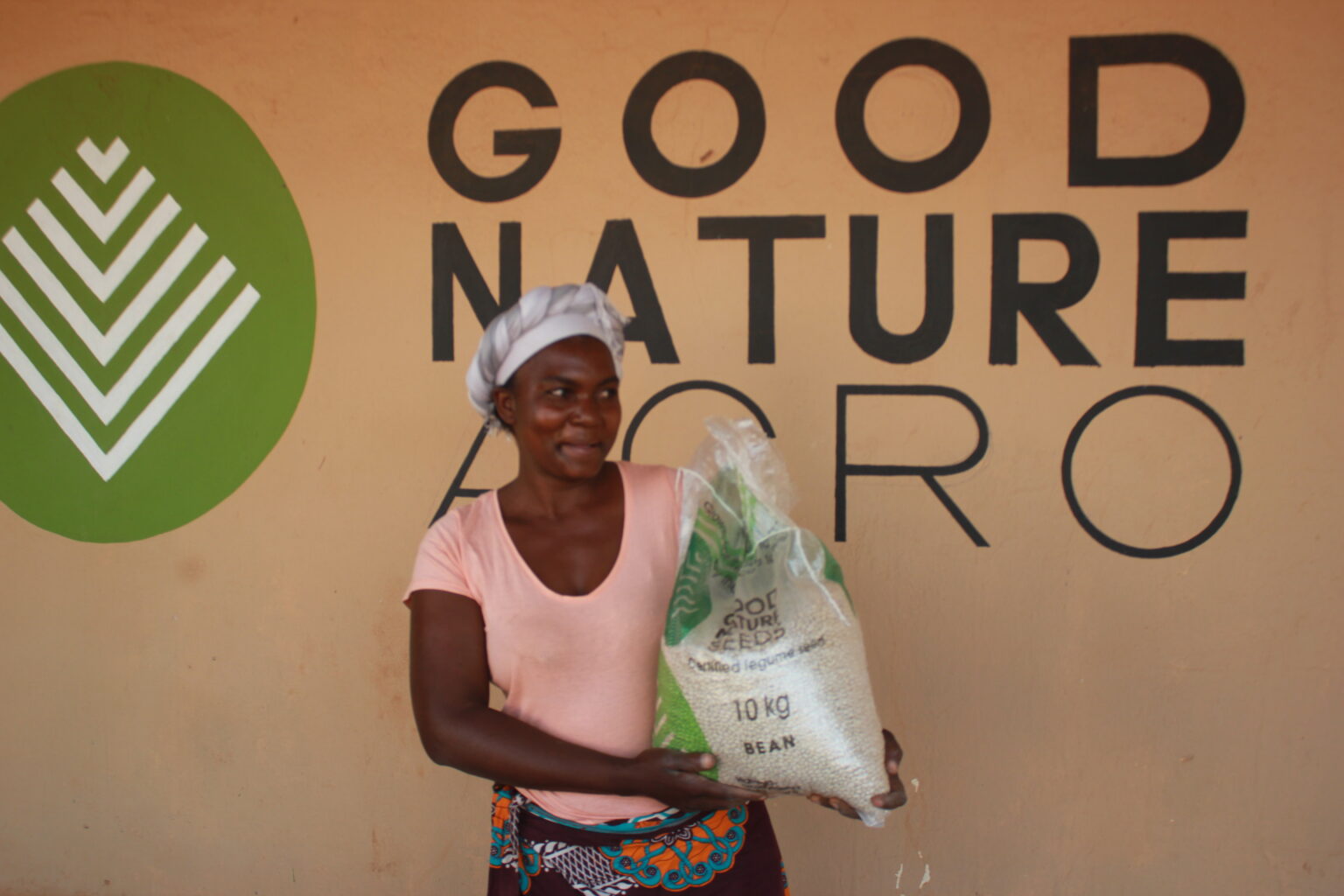
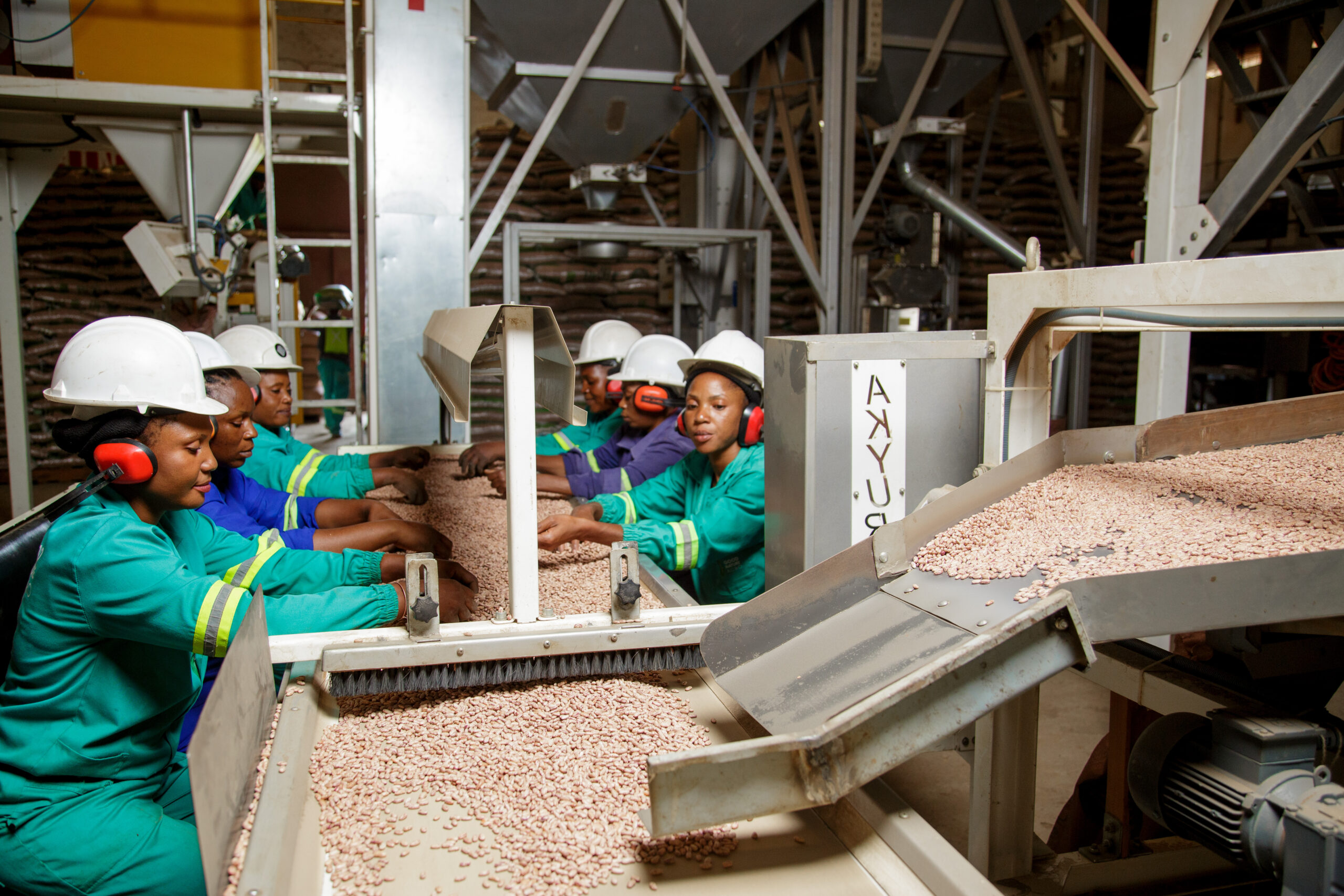
This is the approach on which Good Nature Agro (GNA) was built. The Zambian social enterprise works with smallholder farmers to expand the production of legumes, notably soybeans, beans and groundnuts, for human consumption and animal feed.
Its model rests on three complementary pillars:
- It provides farmers with certified seeds and technical support to improve agricultural practices and yields.
- It secures market access by purchasing farmers’ produce, reducing commercial uncertainty for smallholder households.
- It helps structure local legume value chains by supplying regional processors and reducing reliance on imports.
In a country such as Zambia, where maize has a central role in food systems, expanding crop rotations to include more legumes can be particularly valuable. It can reduce excessive specialisation, improve soil fertility, diversify farm incomes and strengthen resilience to climate and economic shocks.
AgriFI’s role in scaling up
In July 2023, AgriFI signed a long-term financing agreement of $3 million with Good Nature Agro. The investment supports the company’s scale-up, including the construction of a new facility and stronger research and development capacity for seeds.
The initial results are encouraging. In 2025, Good Nature Agro worked with 18,155 smallholder farmers and contributed to the production of 4,648 tonnes of food, despite a historic drought in Zambia.
The strength of GNA’s model lies in its ability to combine economic performance, food security and environmental sustainability. For farmers, access to certified seeds and a reliable market can mean higher yields, greater income visibility and reduced risk. Integrating legumes into crop rotations can improve soil fertility while reducing reliance on synthetic nitrogen fertilisers, which remain costly and subject to significant price volatility.

Lessons for Africa and Europe
The case of Good Nature Agro illustrates an important point: agricultural transition is not solely about introducing new technologies. It also requires financing businesses that can organise markets, support farmers over time and reshape value chains around more sustainable practices.
This is where impact finance has an important role to play. By providing patient capital suited to the risk profile of such businesses, funds such as AgriFI can help innovative models emerge and grow.
The lessons extend well beyond Africa. Diversified crop rotations, the greater use of legumes and reduced dependence on nitrogen fertilisers are increasingly relevant global issues, including in Europe.
In a tense geopolitical context, Europe’s dependence on imported nitrogen fertilisers has become particularly apparent. The EU remains dependent on Russia for around a quarter of its nitrogen fertiliser imports, while disruptions to the Strait of Hormuz, a route through which nearly one-third of global fertiliser exports pass, can further expose this vulnerability.
Reducing dependence on nitrogen fertilisers in Europe would require a significant expansion of land devoted to legumes. Today, legumes account for less than 3% of European arable land; estimates suggest that this area would need to increase five- to sixfold to substantially reduce the use of nitrogen fertilisers.
Supporting European businesses capable of structuring legume value chains at scale is therefore increasingly important. The issue is also closely linked to European food sovereignty: the EU currently imports more than two-thirds of its plant proteins.
About the author
Guillaume Simoes is a Senior Investment Officer at EDFI Management Company. He has 15 years of experience in impact investing and business advisory, with a focus on agriculture and natural-resource management. He has led and structured investments in SMEs, cooperatives, financial institutions and impact funds across Africa and Latin America.